



SEO for IT-Technology Companies: A Practical Guide to Ranking, Trust, and Qualified Leads


Somewhere in your city right now, a business owner just typed “IT support near me” into Google. In the next ten seconds, they’ll click one of the first three results, skim it for thirty seconds, and either pick up the phone — or bounce to the next tab.
That thirty-second window is the entire game. Win it enough times and you build a predictable pipeline of qualified leads. Lose it consistently and you’re stuck relying on referrals and hoping the phone rings.
This playbook is our complete breakdown of how SEO for MSPs actually works in 2026 — not generic SEO advice repackaged for IT companies, but a framework built specifically around how managed service providers get found, get trusted, and get hired. If you finish this and think “I need to talk to these people,” that’s exactly the point — book a call with us at the bottom.
Rank for Terms That Actually Convert
No chasing vanity keywords — every recommendation here is mapped to a real buying stage.
Build Trust Before the First Call
Content built to prove technical credibility so prospects arrive already leaning your way.
A Pipeline That Compounds
Every framework here is designed to keep paying off in year two and three, not just month one.
Built for MSPs, Not Retrofitted
Every example, keyword, and framework here comes from real managed-services search data.
01The Real Reason Most MSP Websites Don’t Convert
We’ve audited hundreds of MSP websites. The pattern is almost always the same: decent design, generic copy, no clear keyword strategy, and zero structure connecting content to the buyer’s actual decision-making process. The site exists, but it isn’t working.
A managed IT services provider website has one job: turn strangers who are worried about their network, their compliance obligations, or their last IT vendor’s failures into people who trust you enough to book a call. Ranking is only step one. MSP SEO services done right engineer both visibility and persuasion into the same asset.
02Map Your Keywords to Buyer Psychology, Not Just Search Volume
The single biggest strategic error we see is MSPs chasing search volume instead of buyer intent. A term like “IT support” might get thousands of searches a month nationally — and convert almost nobody, because it’s dominated by enterprise players and offers no way to tell if the searcher is even in your market.
Instead, every serious MSP SEO agency strategy should organize keywords into an intent pyramid, working from the widest awareness-stage audience down to the smallest, highest-intent group ready to buy:
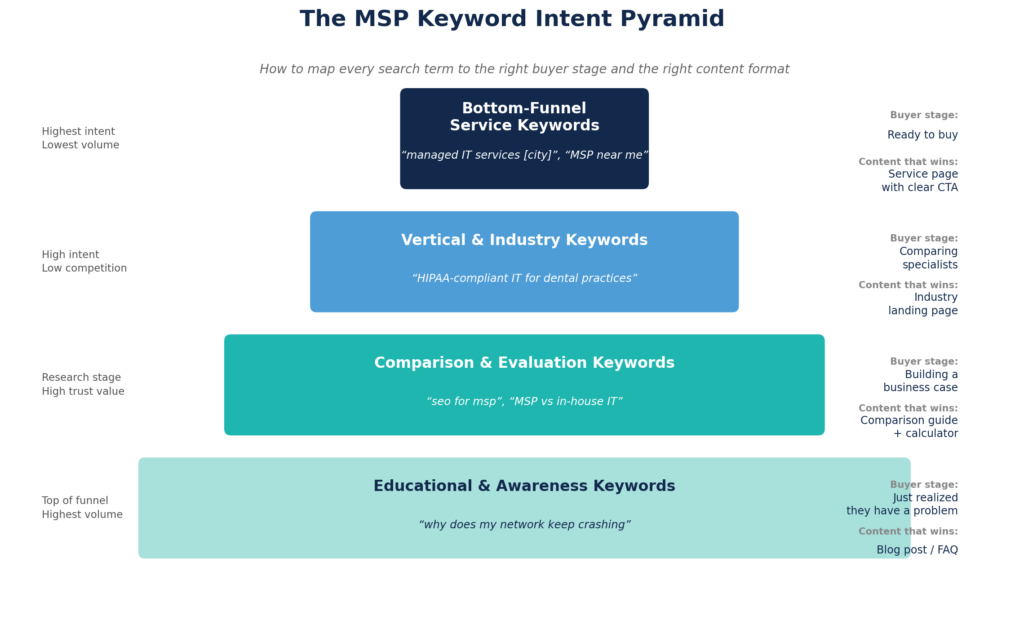
A SEO marketing consultant for MSP growth needs to build content at every layer, not just the bottom one. Notice how the pyramid narrows as intent increases — that’s intentional. The top layer casts the widest net and earns the most traffic, but it’s the narrow bottom layer that actually pays your invoices. A healthy content library has pieces living at every level, each one internally linking down toward the tier below it, so a reader who lands on an educational blog post is naturally guided toward the comparison content, and from there toward the service page where they finally convert.
03Build a Site Architecture Google (and Buyers) Can Actually Navigate
Once your keyword map is built, your site structure needs to mirror it. Confusing navigation and orphaned pages are two of the fastest ways to sabotage otherwise-strong content. A well-structured MSP site typically separates into three clear content pillars:
- Service pillar — managed IT, cybersecurity, cloud, backup & disaster recovery, help desk, compliance
- Industry pillar — dedicated pages for the verticals you specialize in (healthcare, legal, finance, manufacturing, nonprofit)
- Resource pillar — comparison guides, calculators, checklists, and FAQ-driven blog content that feeds the two pillars above with internal links
Every resource-pillar article should link back to a relevant service or industry page. This internal linking structure is what tells Google — and AI answer engines increasingly pulling from structured, well-linked sites — that your business genuinely has topical authority in managed IT services, not just a handful of disconnected pages.
04The Content Engine: A 12-Month Framework That Actually Compounds
Publishing sporadically is worse than publishing nothing, because Google’s crawlers and your prospects both notice inconsistency. Here’s the kind of monthly content cadence that keeps an MSP SEO program compounding instead of stalling out:
| Month | Content Focus | Format | Primary Goal |
|---|---|---|---|
| 1 | Foundational service page rewrite | Core page overhaul | Fix conversion basics |
| 2 | MSP vs. in-house IT comparison | Long-form guide + chart | Support buying committee |
| 3 | Industry-specific compliance guide | Downloadable checklist | Vertical authority |
| 4 | “How to evaluate an MSP” | Evaluation framework | Capture comparison-stage traffic |
| 5 | Cybersecurity risk breakdown | Data-driven blog post | Build topical authority |
| 6 | Downtime cost calculator | Interactive tool | Lead capture + shares |
| 7 | Client case study | Outcome-focused page | Social proof |
| 8 | Local/geo landing page expansion | Location pages | Local search visibility |
| 9 | “Signs it’s time to switch providers” | Problem-agitation post | Capture dissatisfied prospects |
| 10 | Cyber insurance & compliance | Educational guide | Authority + backlinks |
| 11 | Year-end IT risk assessment offer | Lead magnet | Conversion push |
| 12 | Full-site technical & content audit | Internal review | Reset for next cycle |
This cadence balances the four keyword tiers from the pyramid above, so you’re never relying on a single content type to carry the entire strategy.
05Local SEO: Your Unfair Advantage Against National Competitors
National IT brands can outspend you on paid ads. They almost never can out-local you. Local SEO for managed IT services providers isn’t just a Google Business Profile checkbox — it’s a compounding trust signal built from several reinforcing pieces:
- A fully optimized Google Business Profile with accurate service areas, regular posts, and actively managed reviews
- Consistent business citations across local directories, chambers of commerce, and industry associations
- Location-specific landing pages for each city or metro area you actively serve
- Genuine local backlinks from chambers, business journals, and community partnerships
The businesses ranking in the local map pack for MSP SEO services-adjacent local searches almost always have deeper, more consistent local signals than their competitors — not just better on-page optimization.
06The MSP vs. In-House IT Case: Your Best Converting Content Asset
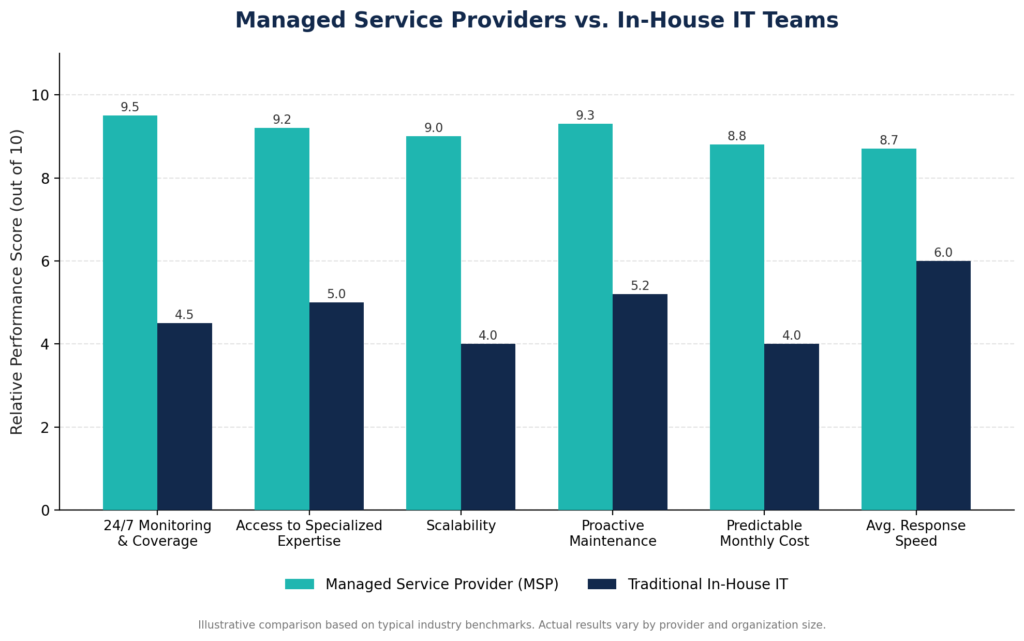
Nearly every MSP prospect is quietly running an internal cost-benefit analysis before they ever contact you: “Is it cheaper and safer to build an internal IT team, or outsource to a managed provider?” Answering that question clearly, on your own site, with real data, is one of the highest-converting content moves available to a managed service provider.
| Factor | Managed Service Provider | In-House IT Team |
|---|---|---|
| Coverage window | 24/7/365 monitoring | Business hours only, typically |
| Monthly cost | Flat, predictable fee | Salary + benefits + training + turnover |
| Expertise breadth | Full specialist bench (security, cloud, compliance) | Limited to hired staff’s skill set |
| Time to scale | Immediate | Weeks to months for new hires |
| Maintenance approach | Proactive, continuous | Often reactive |
| Security tooling | Enterprise-grade, shared cost across clients | Dependent on internal budget |
| Onboarding new tech | Fast, cross-client experience | Slower, learning curve per new tool |
Publishing a page like this — backed by a real comparison chart — does double duty: it ranks well for comparison-stage searches, and it does the internal selling for your prospect before they even call you.
07What SEO Actually Costs an MSP — and What It Returns
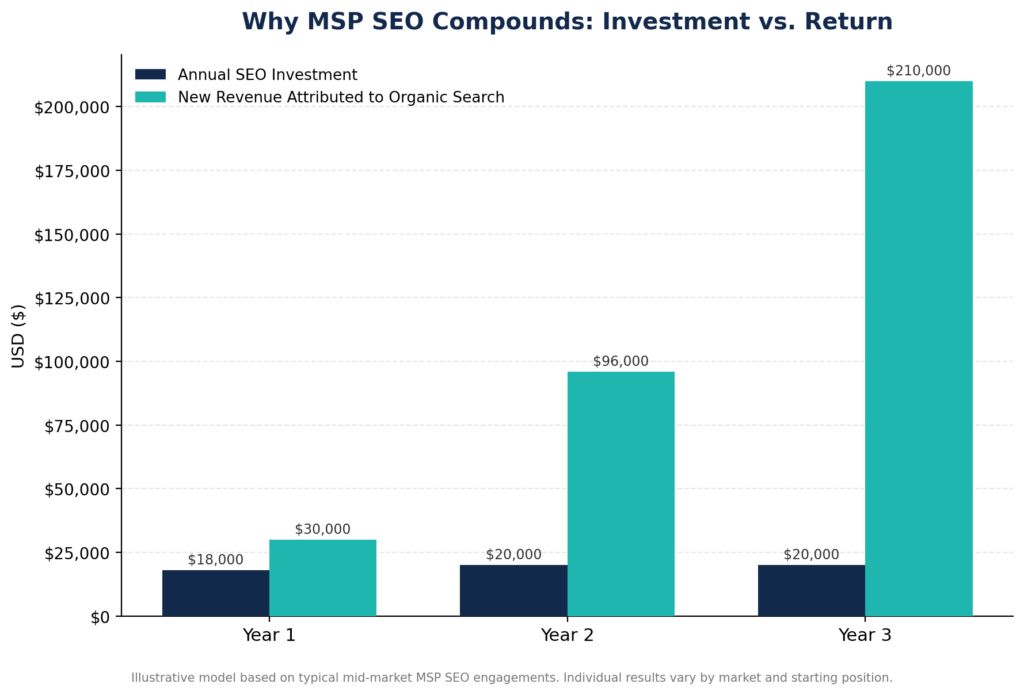
Numbers build trust faster than adjectives. Here’s a realistic, transparent model of what a serious MSP SEO program costs and what it returns as authority compounds year over year:
| Year | Typical Investment | New Organic Leads/Month | Estimated New Revenue |
|---|---|---|---|
| Year 1 | ~$18,000 | 2–4 | ~$30,000 |
| Year 2 | ~$20,000 | 6–9 | ~$96,000 |
| Year 3 | ~$20,000 | 12+ | ~$210,000+ |
The pattern that matters isn’t the exact dollar figures — those vary by market and competition — it’s the shape of the curve. SEO is slow to start and fast to compound. MSPs who quit at month four, right when the foundation is finally in place, throw away the exact period where returns start accelerating.
08Five Mistakes That Quietly Sabotage MSP SEO
- 1Chasing national keywords with a local budget. Competing head-on for “managed IT services” nationally against enterprise players wastes months of budget better spent dominating specific, winnable niches.
- 2Publishing content with no internal linking strategy. Blog posts that don’t link back to service pages generate traffic that never converts.
- 3Ignoring page speed and mobile experience. A slow, dated site actively damages credibility for a company that’s supposed to be a technology expert.
- 4No tracking beyond rankings. Position #3 for a keyword means nothing if you can’t trace it to a form submission or booked call.
- 5Treating SEO as a campaign instead of infrastructure. The MSPs who win treat their content library as a compounding asset, not a quarterly project with a start and end date.
09Frequently Asked Questions
How is MSP SEO different from SEO for other B2B industries?
MSP buyers are evaluating trust, security competence, and reliability simultaneously — not just comparing price and features. Content has to prove technical credibility while still being understandable to a non-technical decision-maker, which is a narrower needle to thread than most B2B categories.
How long before an MSP SEO strategy shows real results?
Expect early movement on long-tail and local terms within 3–4 months, with competitive service-page rankings and consistent lead flow typically building over 6–12 months, and the strongest compounding returns landing in year two and beyond.
Do I need to publish new content constantly, or fix what I already have?
Both, in sequence. We always start by auditing and repairing existing pages — most MSP sites are sitting on content that’s 80% of the way there and just needs restructuring, updated data, and a stronger call to action — before building net-new pages to fill genuine gaps.
What’s the single highest-leverage piece of content an MSP can create?
A well-built, data-backed comparison between managed services and in-house IT, paired with an industry-specific landing page for your top vertical. Together, they capture both the “should I outsource?” research stage and the “who should I hire?” decision stage.
Can I do MSP SEO myself instead of hiring specialists?
You can, if you have consistent hours to dedicate weekly and are comfortable with both technical site work and content strategy. Most MSP owners find their time is worth more spent on client delivery and sales — which is exactly why a specialized MSP SEO agency partnership tends to outperform a part-time internal effort.
When you partner with Jumpfactor, here’s exactly what lands in your inbox:
- A full technical and competitive audit of your current site
- A keyword roadmap mapped to your actual services and markets
- Content built and published by MSP-specialized writers
- Transparent monthly reporting tied to leads, not just rankings
Ready When You Are
Stop Losing Leads to Competitors Who Rank Higher
Every mistake broken down in this guide is fixable — and every MSP ranking above you in your market right now made most of them at some point too. At Jumpfactor, MSP search engine optimization is what we do all day, every day, exclusively for managed service providers.Book Your Free MSP SEO Strategy Session